The Moment Print Became Political Again
Something shifted in 2025. Not gradually. Not in that soft, inevitable way culture usually changes. It landed hard, like a stack of fresh zines hitting a coffee table. Suddenly, “human-made only” wasn’t a quaint selling point—it was a battle flag. Suddenly, the xeroxed, dog-eared, deliberately imperfect zine wasn’t retro nostalgia or hipster affectation. It was resistance.
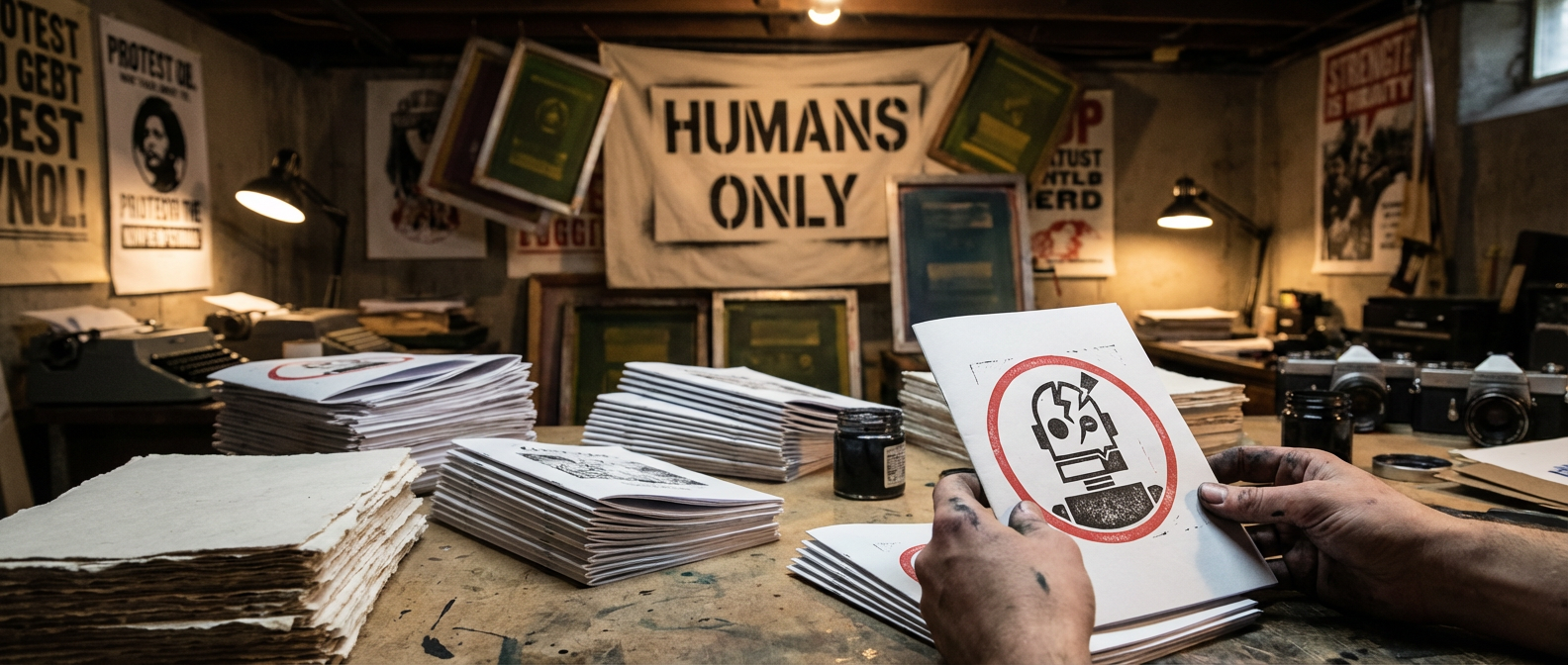
The numbers tell a story worth paying attention to. Portland’s Printed Matter art book fair—traditionally a space where serious collectors browse limited edition art books and photography monographs—saw its first-time zine exhibitor count jump 28 percent between 2023 and 2025. That’s not incremental growth. That’s a demographic shift. That’s young artists deciding that photocopiers are cooler than rendering engines. That’s people physically choosing friction over frictionless.
On Etsy’s marketplace, zines tagged explicitly “AI-free” were moving at a 37 percent price premium over identical unlabeled work. Let that sink in. Consumers were literally paying more for the statement. The label itself became the product. The resistance became the commodity. And somehow, impossibly, it didn’t feel like co-optation. It felt like the first honest market signal we’d seen in years.
The Underground Gets Infrastructure (Without Losing Its Edge)
What made 2025 different from previous zine revivals wasn’t just sentiment. It was organization. In mid-2024, a collective called No Robots formed in Brooklyn. By January 2026, they’d registered over 3,000 zine makers across 14 US cities. They didn’t do marketing campaigns or influencer partnerships. They did what zine culture has always done: made something, passed it hand to hand, let it grow in the spaces between algorithms.
In February 2026, No Robots hosted their first national print fair in Chicago. The event wasn’t trying to be precious or exclusive, but it was curated with the kind of rigor that makes a space feel real. Vendors weren’t there because they’d filled out an application and paid a booth fee. They were there because they’d made something, and other people who made things recognized it as honest work. The distinction matters more than it should.
This is where the infrastructure piece gets interesting. Zine culture didn’t scale by becoming professional. It scaled by becoming more deliberately, more aggressively analog. The No Robots network didn’t build a slick website or centralized distribution hub. They built a network of distributed, autonomous cells. Each city chapter operated independently. The only rule was the rule: make it by hand, keep it weird, don’t let algorithms optimize your voice into algorithmic mulch.
Why Young People Are Choosing the Hard Way
The Society of Publication Designers 2025 industry report found something that should alarm every tech company trying to democratize design: 68 percent of independent print designers under 30 cited “resistance to AI aesthetics” as a primary motivation for choosing analog production. Not nostalgia. Not irony. Resistance.
This generation has watched algorithms their entire conscious lives. They’ve seen how AI-assisted design produces output that looks good and means nothing. They’ve watched TikTok’s algorithm decide what gets seen. They’ve watched Netflix’s recommendation engine calculate “personalization” into homogeneity. They’re done. They’re choosing xeroxes and Risograph printers and hand-cut collages specifically because those tools can’t be scaled infinitely.
There’s something almost radical about it when you think about it. In an era when every tool is trying to make creation frictionless, to remove every barrier between thought and output, young designers are deliberately choosing tools that are slow, imperfect, limited. A Risograph can’t generate 10,000 variations and let you pick the best one. It prints what you designed, and if you made a mistake, the mistake is part of the work now. That constraint is the entire point.
Print Shops as Cultural Centers
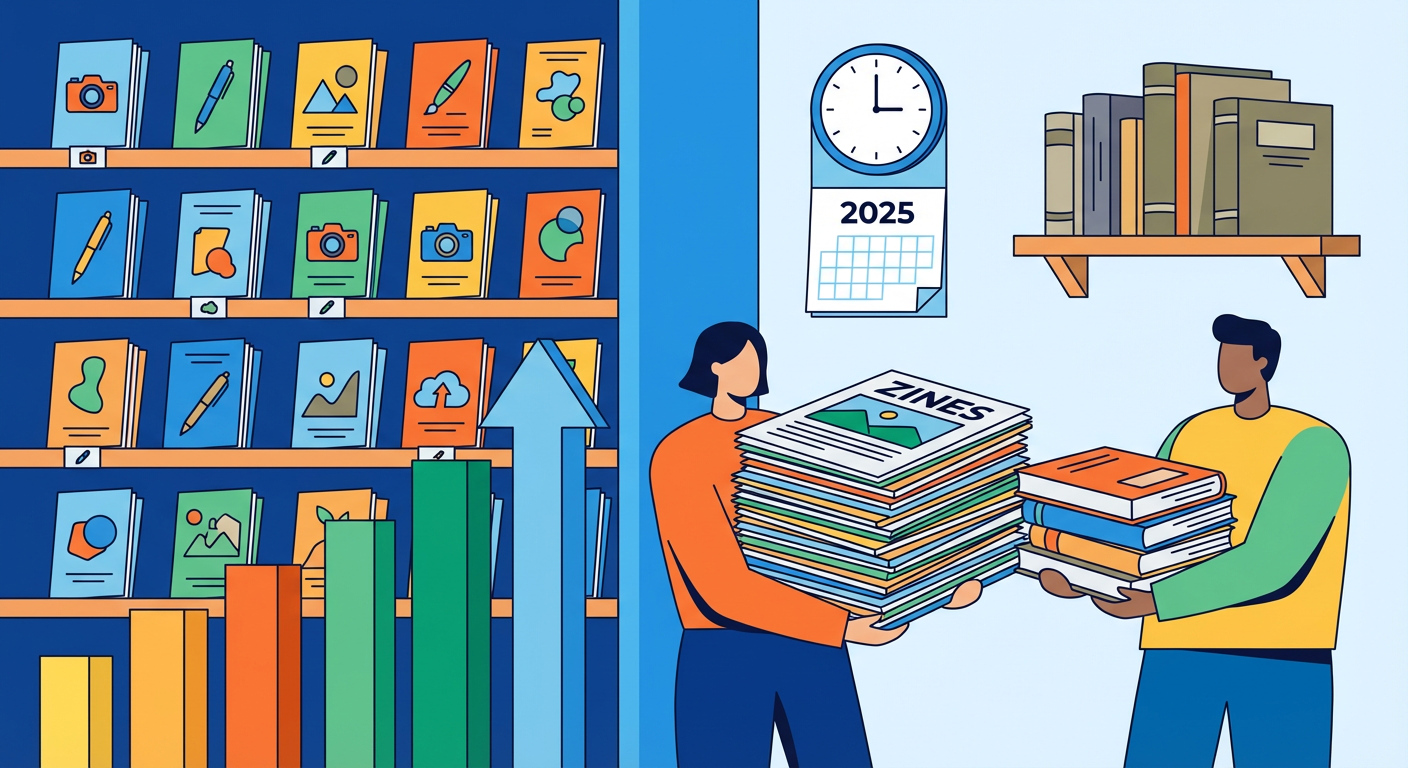
London’s Tenderbooks, a 12-year-old artist book shop, reported something remarkable in their 2025 financials: zine sales outpaced artist monograph sales for the first time in the shop’s history. The zine section grew 55 percent year-over-year in revenue. That’s not just people buying zines. That’s a category inversion. That’s the underground becoming the mainstream object of desire.
What’s happening in these spaces isn’t retail. It’s congregation. Tenderbooks became the physical manifestation of the Printed Matter NYC’s 2025 art book fair recap energy, a place where people who wanted to make things got to see what other people had made, and got the permission (or the permission-less permission) to go make more things.
These spaces matter because they exist outside the attention economy. There’s no algorithm promoting the zine you find at a print shop. No recommendation engine suggesting it based on your browsing history. You find it because you went somewhere, looked at things, talked to people. You find it because you decided to be present in physical space, and the work met you there.
What This Moment Is Really About
The zine renaissance of 2025 isn’t about zines. It’s about sovereignty. It’s about young people watching their culture get fed into machine-learning models, regurgitated as content, optimized for engagement, and deciding that’s not what creation should be. It’s about people choosing tools that can’t be monetized infinitely because the limitation itself is the freedom.
This isn’t sustainable as a permanent state. Culture always gets absorbed. Markets always find a way. But right now, in this moment, there’s a genuine alternative happening. People are making things by hand and distributing them by hand and the fact that it’s slower makes it feel honest in a way nothing else does anymore.
If you’re paying attention, if you’re noticing the shift toward the tangible, the local, the deliberately imperfect, this moment is worth documenting. Not as nostalgia for some imagined analog past, but as evidence that people still want to make culture that isn’t designed by committee or algorithm. What are you seeing in your city? What print culture is growing around you?