Heritage Is a Weapon: How Political Regimes Reshape What Gets Called Cultural Heritage

The Convenient Fiction of Universal Heritage

Every time someone utters the phrase “cultural heritage” with the solemnity of a priest announcing communion, I reach for my metaphorical revolver. Not because heritage doesn’t matter—quite the opposite. It matters so much that whoever controls its definition controls the past, and whoever controls the past, as a certain mustachioed Georgian once demonstrated, controls the future. The word “heritage” sounds neutral, dusty, academic. It is none of these things. It is a political instrument sharp enough to cut glass.

Empty pedestals where monuments once stood in a public square

Cultural heritage, as a concept, pretends to be a museum catalogue: here is what we value, here is what we preserve, here is what we pass down. But that catalogue has been edited. Heavily. By people with specific interests and specific anxieties about their legitimacy. What we call “heritage” is never the sum total of what a culture produced. It is what survived the political filter.

The Selection Process, or: How to Bury Your Ancestors Politely

Consider the Soviet Union, which turned heritage curation into a performance art piece. The Bolsheviks didn’t merely destroy churches; they replaced them. A cathedral blown up in 1931 became a Palace of Soviets—intended to tower over Moscow with a statue of Lenin so large it would have made the Colossus of Rhodes look like a garden gnome. The project never finished, of course. War intervened, and the flooded foundation pit became the world’s most ideological swimming pool. Heritage, in this formulation, was not something to preserve but something to overwrite, like a palimpsest written by committee.

But the Soviets were amateurs at one thing: they announced their erasures. When Stalin’s architects demolished Moscow’s Kitai-Gorod walls, the newspapers said so. There’s a perverse honesty in that. The real professionals—your democratic governments, your European heritage commissions, your UNESCO apparatchiks—perform their selections quietly, through funding decisions, through what they simply forget to nominate for protection.

The Architecture of Forgetting

West Germany after 1945 provides a masterclass in selective memory. The reconstruction of German cities—Munich, Frankfurt, Cologne—was framed as restoring “historic character.” In practice, this meant rebuilding Gothic churches while leaving bombed-out working-class districts as parking lots. Medieval patricians’ houses received meticulous restoration money; the tenements where the actual medieval people lived received bulldozers. Heritage, it turned out, belonged to people who could afford ancestors with real estate.

Ornate historical building facade with classical architectural details

UNESCO’s own founding documents speak of heritage as belonging to “all humanity,” a phrase that should make anyone with a passing knowledge of colonial loot distribution laugh until they herniate. The Universal Declaration of Human Rights declares culture a right; UNESCO declares certain objects worthy of protection. The gap between those two statements contains entire libraries of political negotiation.

Whose Grandmother’s Vase?

The British Museum houses the Parthenon Marbles, the Benin Bronzes, and roughly 8 million other objects acquired through mechanisms ranging from “diplomatic gift” to “we had a bigger navy.” The museum’s argument for retention rests on the concept of “universal heritage”—the idea that certain objects belong to everyone, and therefore to no one specifically, and therefore definitely not to the people who made them. It’s a neat trick. You seize someone’s cultural property, then declare it too important to be confined to one nation. The chutzpah is almost admirable.

But the British aren’t unique; they’re just the most litigated example. Every regime curates. Franco’s Spain preserved Moorish architecture as tourist revenue while suppressing living Arabic language and culture. Maoist China demolished the old city walls of Beijing—2,500 years of continuous urban history—to make way for a ring road, then later designated remaining hutong neighborhoods as “heritage areas” once the damage was done and the property values had risen. Heritage protection, in this timeline, functioned as a postmortem: first you kill the patient, then you stuff and mount it for visitors.

The Erasure Side of the Equation

We talk about heritage preservation because it sounds proactive. We talk less about what I’ll call heritage destruction as governance. The Taliban’s dynamiting of the Bamiyan Buddhas in 2001 was roundly condemned as barbarism, which it was. But the condemnation focused on the act as an aberration—a failure of civilization rather than an expression of it. The Buddhas were destroyed to make a political statement about Islamic purity and Western impotence. The destruction was the heritage project. The absence became the monument.

Weathered stone ruins of an ancient structure against open sky

ISIS later took this logic to industrial scale, destroying Palmyra, broadcasting the demolitions, and then auctioning the antiquities they hadn’t smashed to fund the organization. The circle is perfect: destroy the heritage to demonstrate ideological commitment, sell the fragments to fund further destruction. It’s a business model as old as empire. The Romans did it. The conquistadors did it with Aztec gold. The difference is that ISIS filmed it for Twitter.

The Soft Erasure

Democratic regimes prefer quieter methods. The United States has no federal heritage protection law worthy of the name. The National Historic Preservation Act of 1966 created the National Register of Historic Places, which sounds impressive until you learn that listing provides zero protection against demolition. A listed building can be torn down tomorrow; the listing just means someone has to take a photograph first. It’s heritage protection as scrapbooking—therapeutic for the archivist, useless for the building.

What gets listed is instructive. Plantation homes: well-preserved, frequently visited, gift shops available. Slave quarters: historically “lost,” somehow, despite being right there. The heritage isn’t gone; it was never admitted into the catalogue. The absence is the argument.

Living Heritage, or the Problem with Pickled Cultures

The heritage industry has a new fixation: “intangible cultural heritage.” UNESCO’s 2003 convention extended protection to traditions, oral histories, performing arts—things that breathe. This sounds enlightened until you notice what happens next. Living traditions become “heritage” the moment they become museum exhibits. The moment a ritual is performed for tourists rather than practitioners, it’s already dead; we’re just watching the corpse twitch.

I’ve watched indigenous communities perform ceremonies for heritage documentation teams, then return to their actual spiritual practices in private. The documented version becomes the “authentic” one; the living practice becomes invisible. Heritage, in this framework, is not what people do. It’s what people did, ideally before the cameras arrived.

The politics here are not subtle. When China nominates Tibetan Buddhist practices as national heritage, it claims authority over a culture it actively suppresses. The heritage designation functions as evidence of cultural “preservation”—look, we protect these traditions!—while the actual practitioners are in re-education camps. Heritage becomes alibi. The preservation is the proof of benevolence; the suppression is the practice.

What We Might Do Instead

There’s no clean exit from this problem. Heritage will always be political because the past will always be a resource that the present fights over. But we could at least stop pretending otherwise. We could acknowledge that every heritage list is an editorial decision, and every editorial decision reflects power. We could fund preservation of uncomfortable histories rather than just picturesque ones. We could return what was stolen rather than arguing about “universal” ownership from institutions that are extremely particular about who gets through the front door.

Or we could continue using “heritage” as a term of moral authority while demolishing whatever we find inconvenient. That’s been working for centuries. Why stop now?

FAQ

Isn’t heritage protection better than nothing?

Better than nothing, yes. But “better than nothing” is a low bar for institutions that claim to safeguard human civilization. Heritage protection that preserves castles while demolishing workers’ housing isn’t neutral—it’s an argument about whose history counts. The question isn’t whether protection exists, but what gets protected, and who decides.

How does heritage designation actually work politically?

It varies by country, but the general pattern is: experts recommend, bureaucrats deliberate, politicians approve, funding follows—or doesn’t. In authoritarian states, the decision is centralized and swift. In democratic ones, it’s dispersed among committees, which sounds better until you realize that committees are where inconvenient proposals go to die quietly. In both cases, the outcome reflects power, not merit.

Can cultural heritage ever be truly universal?

Only if we solve colonialism, wealth inequality, and the concept of national sovereignty first. Objects may belong to humanity in some philosophical sense, but the authority to declare them universal belongs to institutions in specific countries with specific geopolitical interests. UNESCO is headquartered in Paris, not Lagos. That’s not an accident; it’s a data point. Universal heritage is a beautiful idea waiting for a world that doesn’t exist yet.


Why Post-Soviet Aesthetics Are Misunderstood by Western Critics

The View From Somewhere Else

There is a particular species of Western art critic who encounters a crumbling Khrushchyovka and reaches for the word “haunting.” The concrete is “stark.” The corridors are “labyrinthine.” The whole scene is “evocative of a lost world.” Lost to whom, exactly? Not to the millions who still live in those buildings, who heat tea on gas stoves older than the critic’s country, who do not experience their own existence as an atmosphere.

Soviet-era residential blocks receding into grey skyline

This is the foundational error: Western criticism treats post-Soviet aesthetics as a mood board, a texture pack, a set of visual signifiers stripped from the material conditions that produced them. The bruised palette of panelki, the specific decay of Cyrillic lettering on a state bakery, the tracksuit as cultural semaphore—these are read as ironic, or nostalgic, or both at once, which the critic considers a sophisticated reading rather than a refusal to engage with what is actually being communicated.

I grew up in a country that no longer exists. I did not experience this as a metaphor.

The Brutalist Misunderstanding

Start with architecture, because Western critics always do, and because they always get it wrong in the same instructive way. Soviet brutalism—though calling it “brutalism” is already a Western taxonomic imposition on a building tradition that did not ask to be classified—is treated as either a fascist monument to state power or an object of ironic appreciation. The critic either recoils or performs aesthetic recovery, and both responses are forms of not looking.

The standard Western framing of Soviet architecture reduces it to a visual language of oppression, which is not wrong so much as it is violently incomplete. Yes, the scale was ideological. Yes, building an entire city around a tractor factory makes a statement about the relationship between labor and the state. But the people who lived in those apartments also painted their kitchen walls yellow and grew geraniums on the balcony and made those spaces habitable through acts of stubborn domesticity that the critic’s framework cannot account for, because the framework only has room for the state, never the people who survived it.

To call a panelka “haunting” is to confess that you have never been inside one. The word you are looking for is “cold.” The word you are reaching for is “poor.” The aesthetic you are admiring is the residue of a housing policy that prioritized quantity over quality because millions had been made homeless by war. That is not atmosphere. That is policy.

The Fashion of Decay

Then there is the fashion. Balenciaga’s fall 2022 show—mud-drenched, deliberately ugly, models carrying trash bags—was received by Western fashion press as a bold statement about the decay of consumer culture. Demna, who is Georgian, who grew up during a civil war, who fled his home at age twelve, was treated as an edgy provocoker rather than someone working through lived experience with material destruction. The collection was “post-apocalyptic.” It was “dystopian.” It was, more accurately, post-Soviet, but that word apparently requires too much specific knowledge.

Figures in dark urban street with weathered walls

The gopnik, the tracksuit, the squat—these have been absorbed into global streetwear as aesthetic choices rather than social positions. A Western designer puts a model in an Adidas tracksuit and calls it “slavcore,” and the internet laughs, and somewhere in Novosibirsk a twenty-year-old is wearing the same tracksuit because it is what he can afford, and the distance between these two facts is the entire problem with Western post-Soviet reception.

The critic will say: but this is irony. The gopnik is performing masculinity. The tracksuit is a semiotic object. And yes, of course it is—everything is a semiotic object once you have been trained to read it as such. But the training itself is a privilege, and the reading is a luxury, and the person being read may not recognize themselves in the translation, because the translation has made them into a symbol rather than a person.

Nostalgia as Lazy Criticism

Svetlana Boym’s distinction between restorative and reflective nostalgia—outlined in her 2001 book The Future of Nostalgia—remains the most useful framework for understanding post-Soviet affect, and also the most consistently misapplied. Western critics cite Boym to diagnose an entire region’s relationship with its past, as if nostalgia were a disease that needs identifying rather than a rational response to having your entire social infrastructure privatized overnight.

When a pensioner in Volgograd tells you that things were better under the Soviet system, she is not being nostalgic. She is describing a material reality in which she had guaranteed housing, free healthcare, and a pension that could buy food. The word for this is not “nostalgia”—it is “memory,” and it is “comparison,” and it is a form of political analysis that Western critics refuse to take seriously because it does not conform to their assumptions about what progressive politics looks like.

The Western critic sees a refurbished Soviet-era snack bar and calls it “ostalgia.” The person eating there calls it “lunch.” The building is not a symbol. The stolovaya is not a set piece. The borscht is not a metaphor. These are places where people eat, and the fact that they were built by a discredited system does not make their continued use an act of political sentimentality.

The Politics That Will Not Stay Outside

Here is the part the Western critic does not want to hear: post-Soviet aesthetics are inseparable from post-Soviet politics because Soviet aesthetics were inseparable from Soviet politics. The state did not simply “influence” the visual culture; it produced it, from the fonts on the subway signs to the layout of the kitchen in your apartment. You cannot extract the aesthetic object from the political system that determined its form, its distribution, its very possibility of existing.

When Western critics treat post-Soviet visual culture as a style, they are performing the same de-politicization that they would immediately recognize as reactionary in any other context. Imagine a critic describing Jim Crow-era architecture as “evocative” without once mentioning segregation. Imagine a review of Weimar art that treated hyperinflation as an aesthetic experience. The omission would be scandalous. Yet for the post-Soviet space, this omission is standard practice.

Weathered concrete façade with geometric window patterns

The reasons for this are structural. Western art criticism operates within a tradition that separates the aesthetic from the political as a matter of professional discipline. The formal analysis comes first; the politics are supplementary, contextual, optional. This is a tradition born of wealth and stability—one that can afford to treat politics as optional because its practitioners have never been subject to a political system that determined the shape of their kitchen appliances.

What We Actually See

When I look at a Soviet mosaic, I see the hand of an artist who was given a commission by a state that both employed and constrained her. I see the tension between the official iconography and the individual skill that animates it. I see a document of a specific mode of production, and I see the degradation that thirty years of neglect have wrought on its surface. I do not see “haunting beauty.” I see an argument between ideology and craft, preserved in tile.

When I look at a Russian crime film from the 1990s, I do not see “gritty noir.” I see a society trying to produce narrative meaning out of a period when the state retreated and organized crime filled the vacuum. The aesthetic of those films—the bad lighting, the improvised violence, the moral economy where loyalty to your crew substitutes for loyalty to a law that no longer protects you—is not a style choice. It is a description of lived social conditions.

The Western critic, arriving at this material from outside, lacks the experience that generated it, and this is not itself a sin. The sin is in treating that lack as a form of objectivity rather than a form of ignorance. The sin is in pronouncing on the meaning of a visual culture while refusing to learn the political vocabulary that gives it sense.

What Would Honest Criticism Look Like?

It would begin by admitting that the post-Soviet is not a mood. It is not a palette. It is not a set of textures to be applied to a Western creative project in need of gravitas. It is a set of specific historical conditions—dispossession, privatization, the collapse of a social safety net, the emergence of oligarchic capitalism, the persistence of state violence—that produced specific visual forms which cannot be understood apart from those conditions.

Honest criticism would treat post-Soviet aesthetics the way it treats post-colonial aesthetics: as a body of cultural production that demands political literacy from its interpreters. It would require critics to learn what perestroika actually did to people’s savings accounts, what “shock therapy” means when you are the one being shocked, what it feels like to wake up in a country whose name has changed overnight. It would demand that the word “haunting” be retired for a decade, or at least until the critic can use it in a sentence that also contains a material fact.

Until then, we will continue to watch our built environment be metabolized into content, our history be aestheticized into atmosphere, and our survival strategies be curated into mood boards. And we will continue to point out, with decreasing patience, that the concrete is not a metaphor. It is a wall. It is cold. People live behind it. That is the entire point.

FAQ

Isn’t some post-Soviet aesthetic genuinely nostalgic?

Of course it is. Nostalgia exists everywhere, and the post-Soviet space is no exception. But nostalgia is not the only affect at work, and it is not the default. Much of what gets labeled “nostalgia” by Western critics is actually something closer to grief, or fury, or dark comedy—all of which are rational responses to the experience of watching your country be disassembled and sold for parts. The problem is not that nostalgia exists; the problem is that Western criticism treats the entire post-Soviet affective range as a single note.

What’s wrong with appreciating post-Soviet visual culture as an aesthetic?

Nothing, if the appreciation comes with an understanding of what produced the aesthetic. The trouble begins when the aesthetic is separated from the conditions of its production—when a panelka becomes “texture” rather than housing, when a tracksuit becomes “fashion” rather than poverty, when decay becomes “atmosphere” rather than neglect. Appreciation without comprehension is extraction. It is the same logic that gave us colonial museums, just with better graphic design.

Can Western critics ever write about post-Soviet culture responsibly?

Yes, but it requires doing the work. Read the history. Learn the politics. Talk to the people who live there rather than to each other. Resist the urge to make everything a metaphor for your own cultural preoccupations. Understand that the post-Soviet space is not your aesthetic playground—it is a place where four hundred million people are trying to survive the aftermath of a catastrophe that your government helped create. If you can hold all of that in your head and still find something meaningful to say about the visual culture, then by all means, say it. Just stop using the word “haunting.”

How Charli XCX’s ‘Brat’ Conquered The Underground Before Anyone Was Watching

The Six-Month Head Start Nobody Talks About

It happened like this: you’re in a Berlin basement in July 2024, sweating through a lo-fi house set, and the DJ drops a track that hits different. The bassline is minimal but intentional. The energy in the room shifts. Suddenly everyone’s phone lights up with the same lime green hex code. By August, that same green is showing up on flyers for warehouse parties in London’s disused industrial zones. By September, it’s everywhere underground but nowhere mainstream.

How Charli XCX's 'Brat' Conquered The Underground Before Anyone Was Watching
How Charli XCX’s ‘Brat’ Conquered The Underground Before Anyone Was Watching

This is the story that Rolling Stone didn’t write until December. By then, Charli XCX’s ‘Brat’ album had already been operating as a cultural operating system in underground club spaces for months, reshaping how promoters thought about theming nights, how DJs curated sets, and what aesthetics mattered to kids who actually shaped club culture instead of just consuming it.

The album hit number three on the UK Albums Chart in June 2024. Fine. A solid pop release. But what happened next was something the music industry’s official chroniclers completely missed: the album’s visual language and sonic DNA didn’t just inspire merchandise or festival programming. It became the blueprint for how independent club promoters thought about creating immersive experiences across Europe’s most important underground venues.

Illustration for How Charli XCX's 'Brat' Conquered The Underground Before Anyone Was Watching
Illustration for How Charli XCX’s ‘Brat’ Conquered The Underground Before Anyone Was Watching

That Specific Green Changed Everything

Pantone 392 C. That’s the official designation for the chartreuse that became synonymous with ‘Brat.’ It’s not a coincidence that designer fabric orders spiked by 214 percent according to Pantone’s 2025 trend report. What that statistic actually represents is club promoters, visual artists, and fashion-forward DJs deliberately sourcing materials to construct environments. They weren’t following a trend. They were building one.

Here’s what’s wild: the color itself became a signal. If you saw that green on a flyer, you knew what you were getting. It wasn’t just aesthetic preference. It was a communicative act. The green meant something specific about the values of the person throwing the party. It meant they were paying attention to cultural production at a granular level. It meant they understood that atmosphere isn’t accidental.

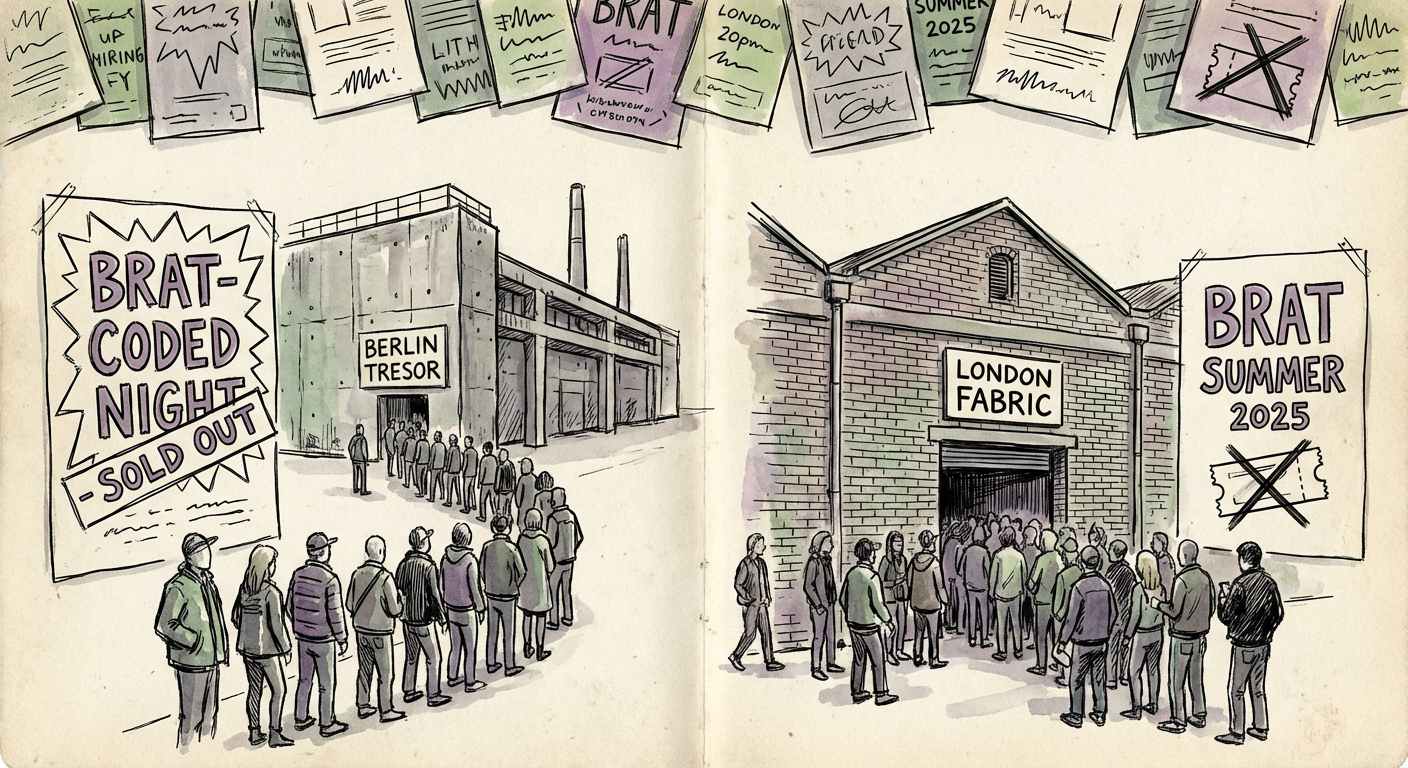
Walk into Tresor in Berlin or what used to be Fabric in London during late 2024, and you’d see promoters selling out ‘Brat-coded’ nights within 48 hours of announcement. Not because Charli XCX was headlining. Not because of major marketing. Because underground club communities understood that this aesthetic represented something worth experiencing in a physical space. The color became currency.

The Algorithm’s Blind Spot

Google Trends data tells one story. ‘Brat aesthetic’ searches peaked in July 2024, which is exactly when the underground was already three moves ahead. But here’s the interesting part: search volume held 60 percent above baseline through the first quarter of 2025, even as mainstream media coverage was supposedly moving on to the next thing. That sustained interest is the difference between a trend and a cultural infrastructure.

The underground wasn’t searching for validation from Google. The underground was building something real. The kids throwing parties in warehouse spaces weren’t waiting for legitimization from major publications. They were creating micro-economies around a specific aesthetic and sonic sensibility. By the time mainstream outlets noticed, the culture had already been established.

This is where the sociology gets interesting. Research from University of Westminster Music Industries Research found that micro-club nights themed around specific album aesthetics grew by 38 percent year-on-year in UK cities. That’s not a spike. That’s a structural shift in how underground communities operate. The ‘Brat’ moment didn’t create this trend, but it absolutely accelerated it and gave it shape.

Why This Matters More Than You Think

The real story here isn’t that a pop album influenced club culture. That’s been happening forever. The real story is that underground spaces maintained complete cultural autonomy while doing it. No brand partnerships. No sponsored activations. No corporate interest in commodifying the experience. Just DJs, promoters, and visual artists taking an album’s aesthetic language and creating something that belonged to them.

What Charli XCX Brat Album Cultural Impact represented was a moment where underground culture and mainstream pop aligned without underground culture having to sell itself out. The album was legible to both worlds. It could exist in a Spotify playlist and in a 200-person warehouse equally. That’s genuinely rare.

But here’s the contradiction I can’t stop thinking about: the very success of ‘Brat’ in underground spaces means it’s now being absorbed into the machinery it was supposedly challenging. That specific green is now available at major fabric retailers. Brands are launching ‘Brat-inspired’ collections. The algorithm caught up. The trend is being monetized.

The Question We Should Actually Be Asking

Was ‘Brat’ ever anti-establishment, or did it just feel that way because nobody was paying attention initially? Did the underground embrace this aesthetic because it genuinely resonated, or because having early access to something before the mainstream validates a certain kind of cultural capital? These aren’t cynical questions. They’re just the honest ones.

What matters most is what happens next in underground spaces. Do promoters move on to the next aesthetic, maintaining the cycle of cultural innovation and absorption? Or does the ‘Brat’ moment create space for something different to emerge? The underground has survived every wave of commodification because it operates on constant regeneration. Stagnation is death.

The real metric isn’t how many people searched for ‘brat aesthetic’ or how many weeks the album charted. It’s whether the kids throwing parties in basements six months from now remember why that green mattered, and whether they’re brave enough to find something new. That’s how underground culture stays underground. That’s how it stays real.

The Ceramics Moment Has Passed. Now Watch the Underground Chase Ferro Cement Into the Margins

The Pottery Peak We Saw Coming

Remember 2023? When every third friend was taking a ceramics class and their apartment looked like a pottery studio exploded? When Instagram galleries were 60% hand-thrown bowls and sculptural vessels? That wasn’t a coincidence. That was peak saturation, and we’re now watching it collapse in real time.

The data confirms what anyone paying attention already knew. Global searches for “pottery classes near me” climbed steadily through early 2024, hit their absolute ceiling in Q2 that year, and then dropped off a cliff. By Q1 2026, searches had fallen 22% from the peak. Twenty-two percent. That’s not a gentle correction. That’s an exodus.

The ceramics renaissance was always going to be temporary. It had all the markers of a trend destined for burnout: accessible entry point, Instagram-friendly output, the parasocial relationship with every ceramicist who went viral on TikTok. It felt democratic. It felt authentic. It felt like you were opting out of capitalism by getting your hands muddy. Except you weren’t. You were just participating in a different version of the same consumption cycle. Better branded. More ethical-looking. Still capitalism.

Why Ceramics Failed to Sustain the Underground

Here’s the uncomfortable truth: ceramics became too easy to monetize. Too neat. Too gallery-friendly. The moment your college roommate could buy your mug on Etsy and your mom could gift it to someone at work, the underground had already moved on. The underground isn’t supposed to be comfortable. It isn’t supposed to be sellable at a farmers market.

Ceramics also suffered from the same problem that kills every art trend that goes mainstream: mass production and skill democratization. Once everyone could access the tools and knowledge, the work stopped meaning anything. Not all of it, obviously. But enough. The signal-to-noise ratio became impossible to parse. A genuinely innovative ceramic artist got lost in a sea of technically competent but artistically empty bowls. The market corrected itself by getting bored.

What actually kills a trend isn’t scarcity. It’s the moment when your parents’ friends start doing it. When your local pottery studio opens a second location. When Whole Foods starts carrying artisanal ceramic dishware. That’s when the people who were there first disappear. Not because they’re snobs. But because the whole point was that it was a space where things still meant something.

The Shift to Industrial Materials: Ferro Cement and the New Frontier

The underground has already moved. If you know where to look, you’ve probably seen it happening. The shift toward industrial materials, specifically ferro cement and hypertufa composites, isn’t just another aesthetic swing. It’s a deliberate rejection of the ceramics paradigm.

The numbers are staggering. Etsy search data from January through October 2025 shows a 180% year-on-year increase in searches for “ferro cement sculpture” and “hypertufa art objects.” That’s not gradual adoption. That’s a stampede. And unlike ceramics, ferro cement carries something ceramics lost: genuine difficulty and risk. You’re working with industrial materials. Concrete. Rebar. Armature. There’s no Instagram filter that makes a failed ferro cement pour look intentional.

This aesthetic is already embedded in the institutional art world, and it’s been there for a while. The NADA Art Fair Emerging Trends report from November 2025 documented that sculptural works using industrial materials represented 19% of emerging artist booths, compared to 3% in 2022. Quadrupling in four years isn’t a trend. That’s a paradigm shift.

Even the supply chain is responding. Blick Art Materials recorded a 290% increase in ferro cement and structural additive sales between Q1 2025 and Q1 2026. When the infrastructure starts shifting, you know it’s real. When art supply stores are scrambling to stock materials, the revolution is already happening at scale.

The Insider Track: What’s Selling and What It Means

In February 2026, Sadie Coles HQ in London mounted a group show featuring seven artists working exclusively in industrial construction materials. The entire inventory sold out on opening night. Not mostly sold out. Completely gone. That level of institutional validation happening that fast means the market already knows where the money is moving.

Ferro cement isn’t precious. That’s the point. It’s accessible, unglamorous, and it looks like something built for permanence rather than decoration. A ferro cement sculpture lives outside. It weathers. It cracks. It ages with intention. This is the anti-ceramics response. It’s not about the object as a finished product. It’s about the process, the material’s refusal to be tamed, and the builder’s relationship to industrial systems and decay.

What’s interesting is that this isn’t entirely underground anymore. But it still feels like it is, because most people aren’t paying attention yet. The ceramics bubble was so visible, so inescapable, that when it popped, everyone noticed. Ferro cement is gaining momentum quietly, through artist networks and alternative gallery spaces and very online art communities. By the time your coworkers are taking ferro cement classes, the real innovators will have already moved to something else.

The Pattern and What Comes After

This cycle will repeat. It always does. The Etsy Trend Report 2025 and institutional gallery data both show the same pattern: emerging material gets adopted by online communities, reaches early commercial traction, gets picked up by mainstream platforms, peaks, plateaus, and gets abandoned by the people who were there first.

The question isn’t whether ferro cement will eventually become the next saturated craft trend. It will. Three years from now, there will be ferro cement studios in every neighborhood, and someone’s mom will post a hypertufa planter on Facebook. The question is what comes next. What’s the material currently being experimented with in studio spaces and garage galleries that we don’t even have language for yet? What’s the next thing that feels difficult and risky and worth making?

The real underground isn’t about the material. It’s about the moment before the material becomes accessible. That moment is always impossibly brief. And the people who chase those moments, who are always looking three months ahead for the next abandoned warehouse, the next emerging medium, the next thing that hasn’t been monetized yet? They’re already moving. They’re already somewhere else. And by the time you read this, they’ve probably already moved twice more.

If you’re noticing ferro cement now, you’re late. That’s not a criticism. It’s just the nature of how these things work. But if you’re curious about what’s actually happening in the margins, the question worth asking isn’t what material you should learn. It’s who you know who’s already moved past the thing you’re just discovering. Find them. Watch what they do next. That’s where the real work is happening.

Haunted Mound: Inside Louisville’s DIY Venue Revolution

The Room That Changed Everything

There’s a moment in every music city’s history when someone decides to stop waiting for permission. Megan Siebe had that moment, and it happened in a converted warehouse in Louisville. Haunted Mound isn’t fancy. The walls are brick. The sound system works most nights. The bathrooms are the kind of bathrooms you find in places that prioritize music over aesthetics. But something shifted when this venue opened its doors. Louisville’s entire underground music ecosystem suddenly had a nerve center.

Haunted Mound: Inside Louisville's DIY Venue Revolution
Haunted Mound: Inside Louisville’s DIY Venue Revolution

What makes Haunted Mound different isn’t mysterious if you pay attention. It’s the $10-and-under door policy, maintained religiously regardless of artist draw or market pressures. That single decision reverberates through everything else. When you keep tickets cheap, you change who shows up. You change what gets booked. You change what gets made. Bandcamp Daily recently documented this model as part of a broader conversation about equitable access in underground venues, naming Haunted Mound as a case study in how pricing shapes culture.

Numbers Don’t Lie, But They Don’t Tell the Whole Story

The attendance numbers are almost beside the point. Louisville’s DIY venue scene experienced a 34 percent capacity increase in 2025, according to Louisville Music News data. That’s not an accident. That’s not an indie music trend cycling through. That’s infrastructure working. Haunted Mound hosted over 200 events in a single year, booking artists like Militarie Gun and Yard Act before those names appeared on major festival lineups. The venue didn’t just host shows. It discovered artists. It validated them before the algorithm did.

But here’s what the numbers can’t capture: the feeling of watching a room figure itself out in real time. The energy when a hundred people show up to hear a band they’ve never heard of because they trust the person who booked them. That’s cultural currency. That’s the opposite of everything TikTok promises you about discovery.

Louisville Is Actually Happening (And Nobody Expected It)

Louisville wasn’t supposed to be a music city. That was the joke for years. Then Pitchfork’s Louisville Renaissance feature named the city as one of three American metros producing the most critically significant independent music outside New York and Los Angeles. Three. That’s it. That’s the tier. Louisville is suddenly in conversation with Brooklyn and LA as an actual creative epicenter.

The irony is thick enough to cut. The moment everyone started paying attention is exactly when locals started worrying that the attention would ruin everything. This is the pattern. You build something authentic in the margins. The margins get discovered. Suddenly there’s money. Suddenly there’s real estate speculation. Suddenly your $10 venue becomes the trendy spot, and then it becomes unaffordable, and then it closes, and everyone mourns it while ordering overpriced cocktails at the venue that replaced it.

Megan Siebe made Louisville Magazine’s 2025 Culture Makers list specifically for building booking practices centered on community rather than profit extraction. That’s not standard. That’s someone making choices that actively work against how venues normally operate.

The Founder as Counterweight

Siebe gets recognition because she’s not playing the game everyone else is playing. She’s running a venue like it’s a public service instead of a business opportunity. The distinction matters. When you run something with that philosophy, you can weather the pressure. You don’t panic-book a major label act to pay rent. You don’t raise door prices because capacity increased. You don’t turn your space into an Instagram backdrop.

This is the kind of leadership that doesn’t get written about enough. The unsexy work of saying no to money. The difficult conversations about keeping doors open to people without disposable income. The structural decisions that ripple through an entire scene.

What Happens Next

Every venue that matters has this moment. The question is whether they survive it. Some do. Some get gentrified. Some get discovered by the wrong people and lose their reason for existing. Some just burn out from the weight of holding down a space while everything around it changes.

Haunted Mound is at that moment now. The whole world is looking. There are definitely people in business suits somewhere thinking about how to monetize what’s happening there. That’s always the threat. That’s always the story in American culture. You build something for love. Someone builds an audience around it. Someone else figures out how to sell it back to that audience.

What makes this different is that there’s someone running the operation who understands that threat and is actively resisting it. Not through gatekeeping or pretense, but through pricing, through booking practices, through community-first decisions that compound over time.

The real question isn’t whether Haunted Mound will stay relevant. Venues with this kind of cultural weight tend to stay relevant. The question is whether it will stay itself. Whether five years from now, someone will still be able to walk in on a Tuesday night, pay ten dollars, and discover something that changes how they hear music.

That’s worth paying attention to. Not because it’s trendy. Not because Pitchfork said so. But because it’s the kind of place that reminds you what art-making actually looks like when people aren’t running the numbers first.

Seoul’s Micro-Neighborhoods Are Rewriting the Rules of Urban Cool

The Seongsu Moment That Changed Everything

Three years ago, Seongsu was the kind of place you’d accidentally stumble into while lost on the subway. A former industrial district in southeast Seoul, it had the bones of something interesting – warehouse conversions, vintage shops, the skeletal remains of a manufacturing past – but it wasn’t on anyone’s radar. Then something shifted. What started as a handful of creative types setting up coffee roasteries in old factories turned into something the internet couldn’t look away from. By late 2025, Nike, Gentle Monster, and Jacquemus all planted flagship pop-up experiences in the neighborhood within a six-month window. Each one pulled over 100,000 visitors. That’s not viral success. That’s cultural tectonic plates moving.

The numbers tell a story that feels almost too convenient to be real. Commercial rents in Seongsu increased 210 percent between 2022 and 2025. That’s not gradual gentrification. That’s a neighborhood being discovered, packaged, and monetized at speeds that would make venture capitalists weep. But here’s what matters more than the percentage: that number marks the exact moment when something authentic got absorbed into the machine. The warehouse parties became Instagram experiences. The independent galleries became backdrops for brand activations. The cool became content.

Hyper-Local Branding Is the New Arms Race

This isn’t just happening in Seoul. This is happening everywhere, and Seoul figured it out first. According to the McKinsey Global Institute Urban Retail Report 2025, “hyper-local neighborhood branding” ranks among the five most transformative forces reshaping how cities think about retail and culture right now. Translation: every major city is now running the Seongsu playbook. Find an overlooked neighborhood. Build a micro-identity around it. Turn it into an aesthetic. Watch corporations line up to colonize it.

The strategy works because it feels authentic in a way that mall-based retail never could. A pop-up in Seongsu doesn’t feel like shopping. It feels like discovering something real, something that exists because artists and entrepreneurs chose to build there, not because a corporation decided consumers should want it. But that’s the genius and the tragedy of hyper-local branding. It takes genuine cultural energy, the kind that takes years to build organically, and compresses it into a marketable moment. The neighborhood becomes a character in the brand’s story. The residents become extras in someone else’s narrative.

Seoul’s Micro-Neighborhoods Are Exporting Their Own Aesthetic

Talk about “Seongsu-core” on TikTok and you’re looking at 2.1 billion views in 2025 alone. That’s one of the most geo-tagged aesthetic movements the platform has seen. Not a subculture. An aesthetic tied to a specific place, which means it’s infinitely reproducible anywhere. You don’t need to actually go to Seongsu to participate in Seongsu-core. You can stage the brick walls, the vintage finds, the carefully curated emptiness of an artfully lit warehouse in your own city. The neighborhood becomes a template. The specificity that made it special gets diluted into a style guide.

This is where it gets genuinely interesting from a cultural studies perspective. Tourism to Seoul’s non-traditional districts, places like Mangwon and Ikseon-dong, grew 34 percent in 2025 compared to 2024, per the Korea Tourism Organization 2025 Urban Travel Trends. Tourists aren’t going to see Seoul. They’re going to experience Seongsu. They’re going to the places they already saw on TikTok, hitting the same coffee shop, standing in the same spot, generating the same content. The neighborhood stops being a place and becomes a destination, which is actually a completely different thing. One is alive and messy. The other is choreographed.

What Happens When Cool Becomes Predictable

Here’s the contradiction nobody wants to admit: the more successful these micro-neighborhoods become, the less interesting they actually are. We’ve seen this play out in Brooklyn, in Barcelona, in every neighborhood that got written up in the right magazine at the right time. The original residents and creators get priced out. The independent businesses get bought out by corporations playing at authenticity. The neighborhood becomes a museum dedicated to its own former self, preserved in amber but stripped of the actual cultural production that made it worth preserving.

The tension is real because the infrastructure that makes a neighborhood work, affordable rent, independent businesses, mixed-income communities, is fundamentally incompatible with the hype cycle that creates global attention. You can’t both build authentic creative culture and be a top-tier tourist destination. The math doesn’t work. Seoul’s experiment with hyper-local branding is brilliant and devastating precisely because it exposes this contradiction so clearly. Every major international brand wants access to the cultural credibility that a neighborhood like Seongsu offers. But that access, the moment it happens, kills the thing that made it credible in the first place.

The Question Nobody’s Really Asking

The real story here isn’t about Seongsu or pop-up fashion or aesthetic movements. It’s about power, specifically about who gets to decide what a neighborhood means and who benefits when that meaning gets distributed globally. Every brand activation, every influencer visit, every TikTok view that drives tourism numbers up is another brick in the wall separating a place from its residents. The neighborhood becomes a character in someone else’s story. The people who actually live there become part of the scenery.

So what’s the alternative? There probably isn’t one, at least not within existing systems of real estate and retail capitalism. But understanding this dynamic, seeing how neighborhoods get identified, packaged, and consumed, is the first step toward something like resistance. The next time you see a micro-neighborhood trending, before you book the flight or stage the Instagram photo, ask yourself what’s actually being preserved when a place becomes globally famous for being authentic. Ask who’s getting richer and who’s getting pushed out. Ask whether cool can survive at scale or if what we’re calling cool is actually just really effective marketing. The answer matters more than you might think.

Afrobeats’ Beautiful Mess: When a Genre Outgrows Itself

The Numbers Don’t Lie, But They Don’t Tell the Whole Story Either

Something strange happened in 2025. Afrobeats kept growing, streams kept multiplying, and yet the genre suddenly felt less coherent than it did three years ago. According to Spotify Loud & Clear 2025, global Afrobeats streams surged 47 percent year-over-year. The infrastructure expanded. More countries entered the conversation. And somehow, in the process of becoming bigger, Afrobeats became blurrier.

The shift is quantifiable. Nigerian artists, who dominated 72 percent of Afrobeats streams in 2023, now account for just 61 percent. That’s not a modest correction. That’s a serious reorganization. Ghanaian producers. Tanzanian vocalists. Diaspora kids making beats in London and Brooklyn. They’re not waiting for permission. They’re simply making music that fits under the Afrobeats umbrella, and that umbrella is getting bigger every quarter.

Meanwhile, Billboard’s Afrobeats Chart tells its own version of this story. When it launched in 2022, it tracked artists from eight countries. By January 2026, that number had swelled to fourteen, with over fifty charting acts competing for space. That’s not growth. That’s fragmentation wearing a growth mask.

The Panel Where Everything Got Real

The conversation got uncomfortable in Lagos during the 2025 Afrobeats Summit. Producers, label executives, and sonic architects gathered in one room to discuss the state of their own movement, and what emerged was less panel discussion, more philosophical crisis. The Guardian documented the heated moments, and the core question kept surfacing: Does “Afrobeats” even mean anything anymore?

One perspective held that the label had become a marketing category, a catch-all that sacrificed cultural specificity for commercial appeal. Another argued that genre fluidity was precisely the point, that Afrobeats had always been a conversation between Nigerian highlife, Ghanaian hiplife, dancehall, amapiano, and electronic experimentation. Why pretend it was ever a fixed thing? The tension revealed something important. The artists caught in this moment weren’t confused about their own work. They knew exactly what they were doing. The confusion belonged to the people trying to categorize them.

What made the panel revelatory wasn’t consensus. It was the opposite. These were people who had built Afrobeats together, now interrogating whether the structure they’d created was serving them or constraining them. That’s the sound of a subculture graduating into complexity.

Amaarae’s Quiet Revolution

Amaarae’s “Fountain Baby: Deluxe Sessions” landed in 2025 and did something that felt simultaneously inevitable and shocking. A Ghanaian-American artist making moody, bass-inflected pop arrived at the UK Albums Chart at number four. She became the first Ghanaian-American woman to crack the top five. It’s a statistic that looks like a ceiling broken. What’s more interesting is what it signals about who gets to represent Afrobeats now.

Amaarae isn’t the loudest voice in the room. Her production choices favor subtlety over spectacle. She’s moved away from Afrobeats’ core sound signature, that immediate percussive warmth, in favor of something more diffuse and introspective. She’s making music that exists in the genre but doesn’t feel bound by it. And the chart position proves there’s an audience already there, waiting for that kind of boundary-pushing.

Her success isn’t an aberration. It’s a pattern. The most interesting music coming out of this ecosystem right now tends to come from artists who treat Afrobeats as a starting point rather than a destination. They borrow the rhythmic DNA, the production textures, the cultural references, and then drag them into conversations with other sounds entirely.

Rema and Arca: The Signal Everyone Missed

When Rema collaborated with producer Arca in November 2025, the internet mostly moved on. But Pitchfork caught it, describing the pairing as “the clearest signal that Afrobeats’ next chapter is genre dissolution, not consolidation.” That’s not hyperbole. That’s notation.

Arca’s production philosophy is fundamentally anti-genre. She works in texture and abstraction, fractured rhythms, warped vocals, and the spaces between traditional song structures. Pairing her with Rema, one of Nigeria’s most commercially successful contemporary artists, wasn’t really a collaboration. It was a collision between two creative philosophies. And the result is music that lives somewhere else entirely, in a territory that doesn’t have a name yet.

This is what happens when a genre goes global. The artists stop asking permission from the original epicenter. They start asking their own questions. Can I take this sound and layer it with ambient production? Can I slow it down until it becomes something else? Can I smash it against electronic experimentation? The answer is always yes. And the yes is creating the interesting work.

The Beautiful Mess We’re Living In

Here’s the thing about Afrobeats’ identity crisis: it’s not actually a crisis. It’s maturation. The genre spent its first decade proving it could dominate commercial spaces. Now it’s proving it can exist everywhere simultaneously, in different forms, with different intentions, without losing its connection to its origins.

The artists caught in the middle aren’t struggling. They’re thriving. They’re making decisions that confuse categorization but clarify their own artistic voices. They’re taking production techniques developed in Lagos and Accra and London and applying them to music that doesn’t fit any established box. A genre doesn’t have to be monolithic to be coherent.

What makes 2026 feel like a turning point is that nobody’s pretending there’s one version of Afrobeats anymore. The conversation has shifted from “Is this Afrobeats?” to “How is this artist using Afrobeats elements to say something new?” That distinction matters. It means the genre has developed enough complexity to contain multitudes. It means the next chapter is being written by artists who feel empowered to break their own rules.

What are you hearing? What sounds feel like the future of this moment? I’m genuinely curious what’s catching your ear in these blurry spaces where Afrobeats dissolves into everything else.