The Six-Month Head Start Nobody Talks About
It happened like this: you’re in a Berlin basement in July 2024, sweating through a lo-fi house set, and the DJ drops a track that hits different. The bassline is minimal but intentional. The energy in the room shifts. Suddenly everyone’s phone lights up with the same lime green hex code. By August, that same green is showing up on flyers for warehouse parties in London’s disused industrial zones. By September, it’s everywhere underground but nowhere mainstream.

This is the story that Rolling Stone didn’t write until December. By then, Charli XCX’s ‘Brat’ album had already been operating as a cultural operating system in underground club spaces for months, reshaping how promoters thought about theming nights, how DJs curated sets, and what aesthetics mattered to kids who actually shaped club culture instead of just consuming it.
The album hit number three on the UK Albums Chart in June 2024. Fine. A solid pop release. But what happened next was something the music industry’s official chroniclers completely missed: the album’s visual language and sonic DNA didn’t just inspire merchandise or festival programming. It became the blueprint for how independent club promoters thought about creating immersive experiences across Europe’s most important underground venues.
That Specific Green Changed Everything
Pantone 392 C. That’s the official designation for the chartreuse that became synonymous with ‘Brat.’ It’s not a coincidence that designer fabric orders spiked by 214 percent according to Pantone’s 2025 trend report. What that statistic actually represents is club promoters, visual artists, and fashion-forward DJs deliberately sourcing materials to construct environments. They weren’t following a trend. They were building one.
Here’s what’s wild: the color itself became a signal. If you saw that green on a flyer, you knew what you were getting. It wasn’t just aesthetic preference. It was a communicative act. The green meant something specific about the values of the person throwing the party. It meant they were paying attention to cultural production at a granular level. It meant they understood that atmosphere isn’t accidental.
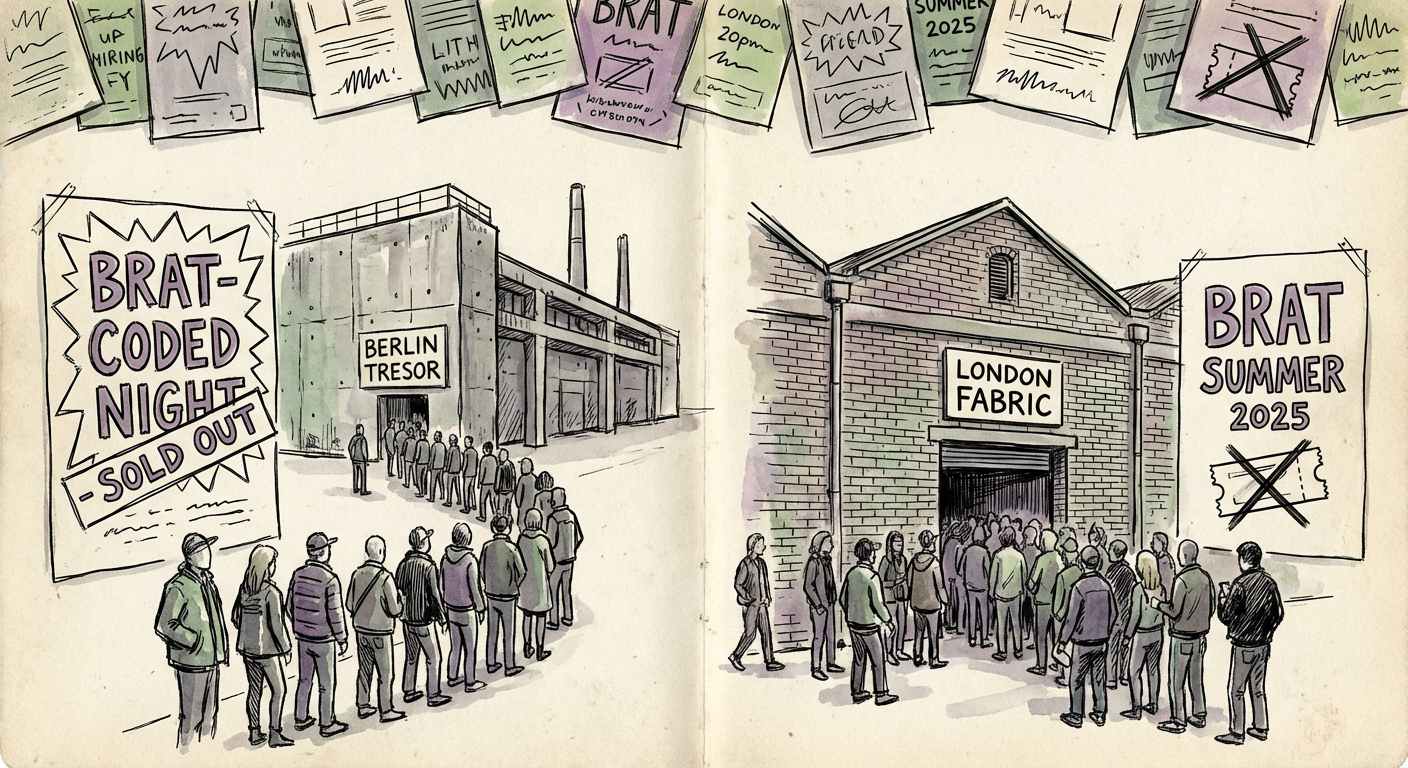
Walk into Tresor in Berlin or what used to be Fabric in London during late 2024, and you’d see promoters selling out ‘Brat-coded’ nights within 48 hours of announcement. Not because Charli XCX was headlining. Not because of major marketing. Because underground club communities understood that this aesthetic represented something worth experiencing in a physical space. The color became currency.
The Algorithm’s Blind Spot
Google Trends data tells one story. ‘Brat aesthetic’ searches peaked in July 2024, which is exactly when the underground was already three moves ahead. But here’s the interesting part: search volume held 60 percent above baseline through the first quarter of 2025, even as mainstream media coverage was supposedly moving on to the next thing. That sustained interest is the difference between a trend and a cultural infrastructure.
The underground wasn’t searching for validation from Google. The underground was building something real. The kids throwing parties in warehouse spaces weren’t waiting for legitimization from major publications. They were creating micro-economies around a specific aesthetic and sonic sensibility. By the time mainstream outlets noticed, the culture had already been established.
This is where the sociology gets interesting. Research from University of Westminster Music Industries Research found that micro-club nights themed around specific album aesthetics grew by 38 percent year-on-year in UK cities. That’s not a spike. That’s a structural shift in how underground communities operate. The ‘Brat’ moment didn’t create this trend, but it absolutely accelerated it and gave it shape.
Why This Matters More Than You Think
The real story here isn’t that a pop album influenced club culture. That’s been happening forever. The real story is that underground spaces maintained complete cultural autonomy while doing it. No brand partnerships. No sponsored activations. No corporate interest in commodifying the experience. Just DJs, promoters, and visual artists taking an album’s aesthetic language and creating something that belonged to them.
What Charli XCX Brat Album Cultural Impact represented was a moment where underground culture and mainstream pop aligned without underground culture having to sell itself out. The album was legible to both worlds. It could exist in a Spotify playlist and in a 200-person warehouse equally. That’s genuinely rare.
But here’s the contradiction I can’t stop thinking about: the very success of ‘Brat’ in underground spaces means it’s now being absorbed into the machinery it was supposedly challenging. That specific green is now available at major fabric retailers. Brands are launching ‘Brat-inspired’ collections. The algorithm caught up. The trend is being monetized.
The Question We Should Actually Be Asking
Was ‘Brat’ ever anti-establishment, or did it just feel that way because nobody was paying attention initially? Did the underground embrace this aesthetic because it genuinely resonated, or because having early access to something before the mainstream validates a certain kind of cultural capital? These aren’t cynical questions. They’re just the honest ones.
What matters most is what happens next in underground spaces. Do promoters move on to the next aesthetic, maintaining the cycle of cultural innovation and absorption? Or does the ‘Brat’ moment create space for something different to emerge? The underground has survived every wave of commodification because it operates on constant regeneration. Stagnation is death.
The real metric isn’t how many people searched for ‘brat aesthetic’ or how many weeks the album charted. It’s whether the kids throwing parties in basements six months from now remember why that green mattered, and whether they’re brave enough to find something new. That’s how underground culture stays underground. That’s how it stays real.